Chapter 1.0: Summary
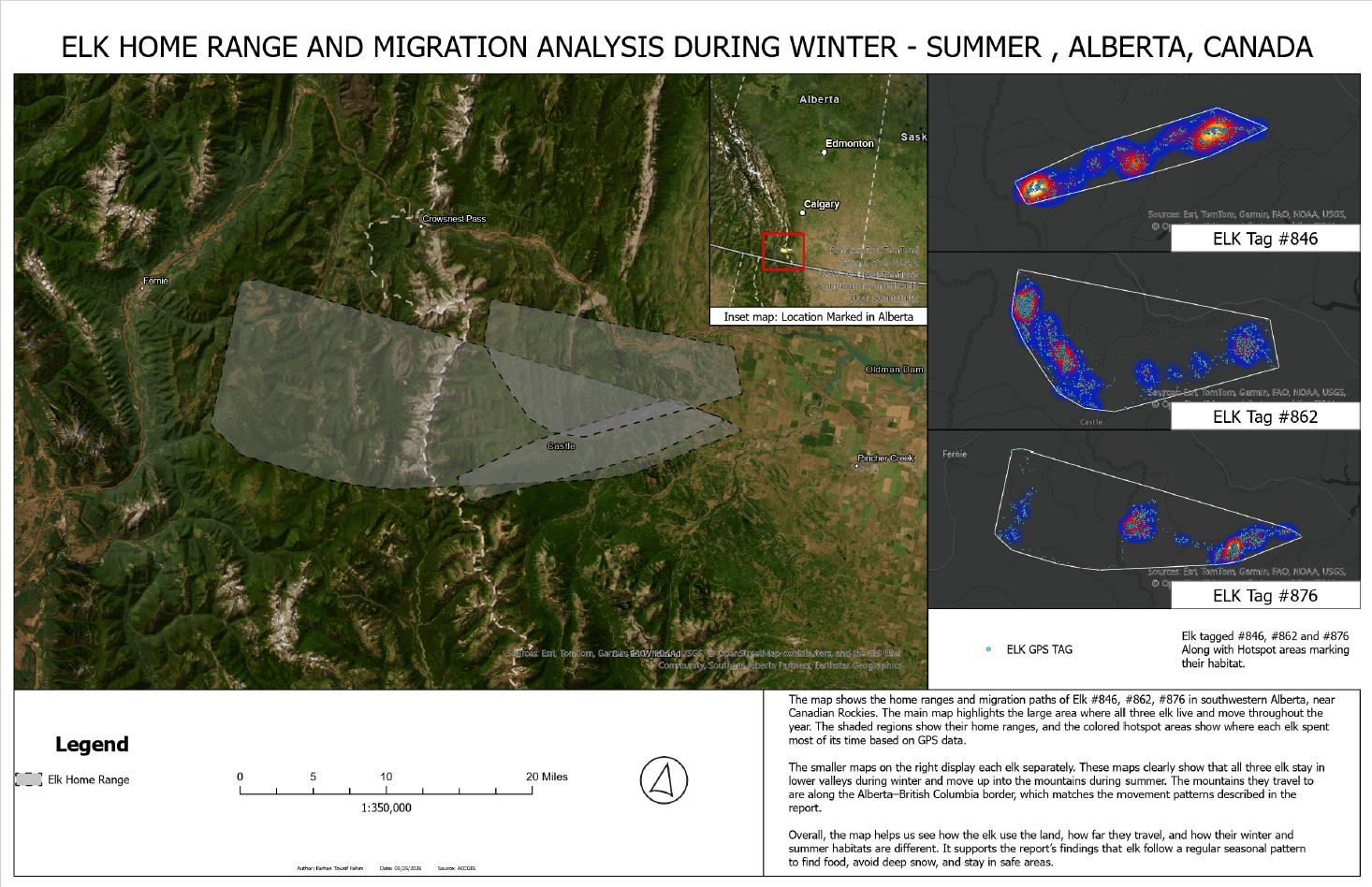
ELK are majestic creatures that roam the vast landscapes of Western North America. One of the most fascinating aspects of their behavior is their seasonal migration. In the western part of Northern America, migration is a defining part of their life cycle. Twice each year, these animals travel between separate summer and winter ranges, it’s a strategy that helps Elk cope with the shifting of harsh weather, food availability and habitat conditions. The distance they travel can vary significantly. Elks can travel from short, local shifts to long journeys across mountain systems, but for many Elks, this migration is essential for survival in the rugged, hard, unforgiving cold of the North America especially in Canada. Their Seasonal movement is far from random. Instead, it reflects a fine tuned ecological reason for nature’s adaptation. As the seasons change, Elf adjust their location to adapt themselves with the best possible resources like food, shelter and safety. In winter. Elk descends to lower elevations where snow is shallower, and food is easy to reach. When summer comes with its warm weather traits, Elks move back up towards the higher mountain slopes, when food is abundant and rich vegetation appears after snow melts. In this report we have selected 3 Elks that are tagged with tag numbers 846, 862 and 876 to explain and the reason I am demonstrating with such a small number is because it is easier to explain and show the migration process of the Elk. All of the 3 Elks are from Alberta, Canada.
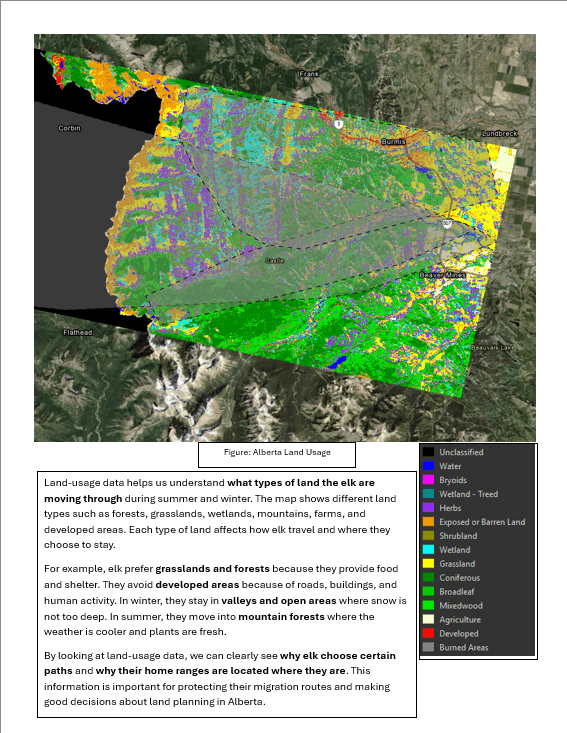
We can expect to see a typical pattern for the Elk’s migration. During Summer they travel from Low to High elevations. These areas provide an ideal environment for feeding and repopulating. When harshness of Winter comes, the Elks migrate from higher altitude to lower altitude. I will attach a Land Usage Map to explain some aspects of the Elk’s migration.
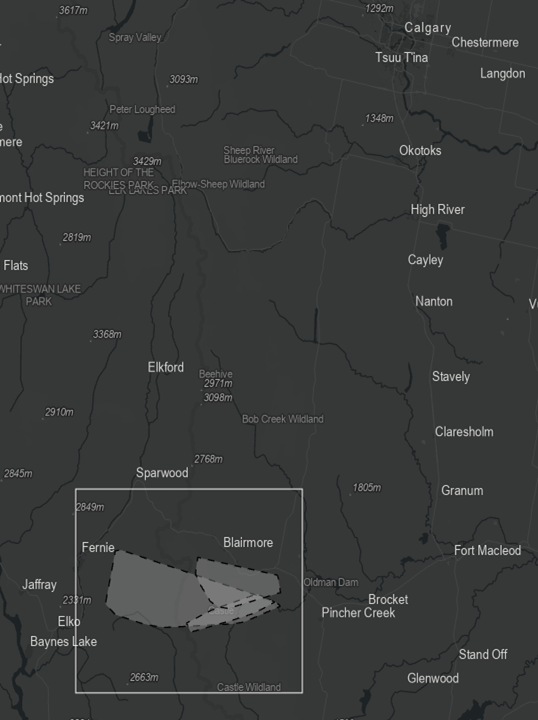
The three areas marked and enclosed in the white rectangle map of Alberta are the Home range for the Elks #846, 862 and 876 separately.
Chapter 2.0: Body:
This is a report on Elks tagged #846, #862 and #876, to show and explain the migration from their summer to winter home ranges. At first each of the Elk’s tag reading and their time frame will be explained.
ELK #846
The ELK #846’s home range and its migration pattern is quite fascinating when compared alongside Summer season vs Winter season. Their migration is not random at all.
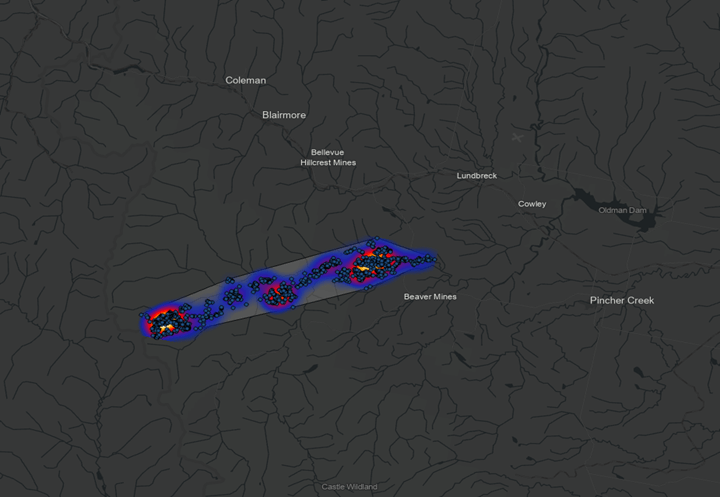
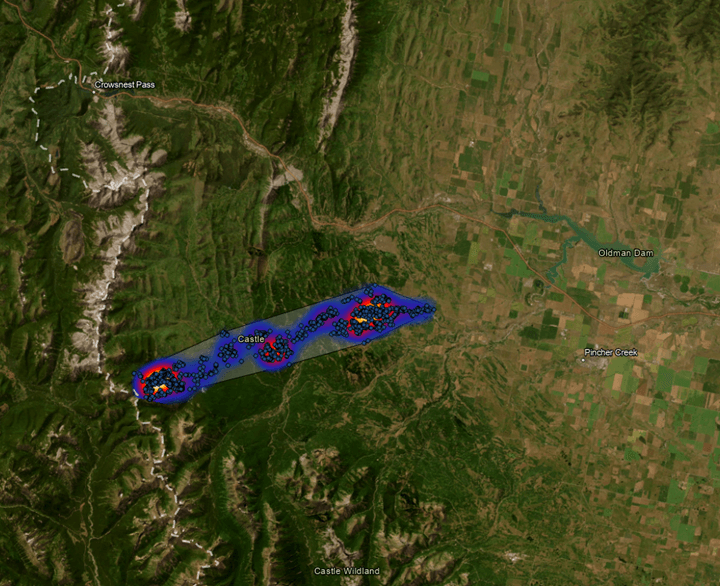
Elk Tag #846 demonstrates a well‑defined seasonal migration pattern typical of elk populations inhabiting the eastern slopes of the Canadian Rockies. This individual moves between distinct winter and summer habitats within its established home range, responding to annual shifts in snow cover, forage availability, and climatic conditions. During winter, the elk occupies lower‑elevation valley environments where snow depths are reduced and vegetation remains more accessible, enabling greater energy conservation during periods of environmental harshness. As spring advances and snow recedes, Elk #846 gradually transitions upslope toward the mountainous terrain of Canadian Rockies. This region represents the section of the Rocky Mountain range that forms the natural boundary between Alberta and British Columbia, and it provides high‑quality summer habitat characterized by cooler temperatures and abundant, nutrient‑rich vegetation. With the onset of autumn, the elk returns to lower elevations, completing a biannual migratory cycle that enhances survival by optimizing access to seasonal resources while minimizing exposure to severe winter conditions.
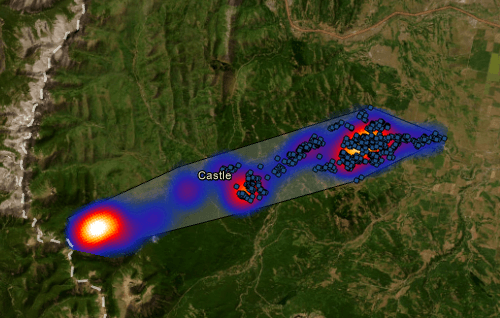
The Elk seems to enjoy the Lower altitude and valleys of the Canadian Rockies during winter time from January to April where is terrain is easier to travel than frozen mountains.
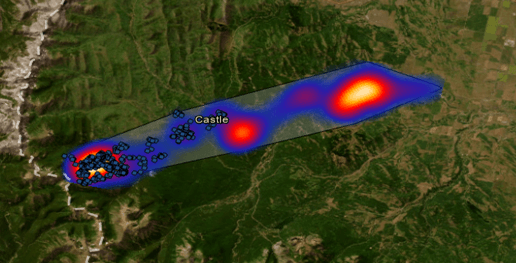
During Summer time from May-October Elk #846 moves up the mountain range of the Canadian Rockies where it stays and then when winter comes at around end of November and Early December, the Elk #846 comes down to the east side of the mountain range towards the Valley where it stays during the Winter.
ELK #862
Elk Tag #862 demonstrates a predictable seasonal movement pattern that aligns with the broader migratory behavior observed in elk populations along the eastern slopes of the Canadian Rocky Mountains. These movements occur within a defined home range and are driven primarily by changes in weather, forage availability, and habitat conditions throughout the year.
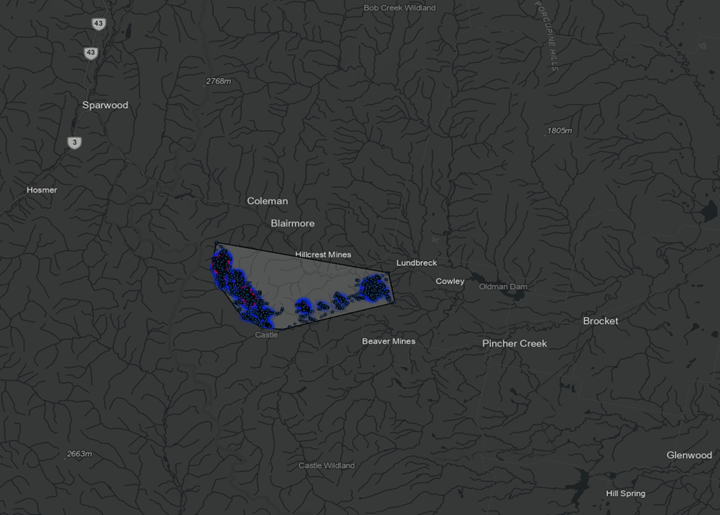
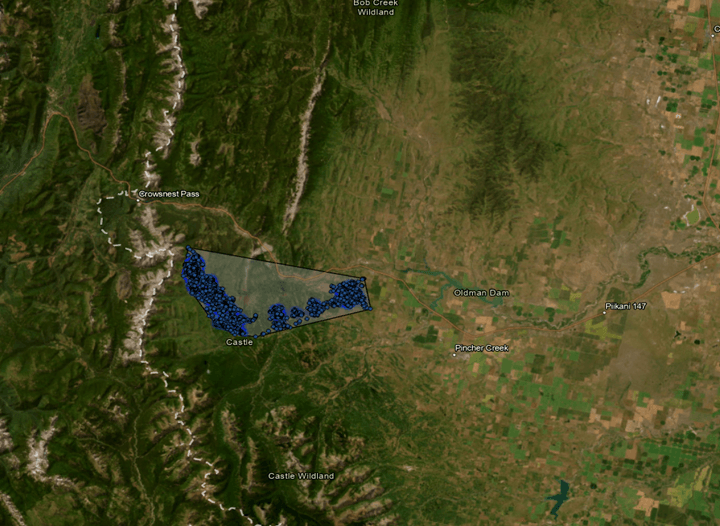
Elk Tag #862 follows a consistent seasonal migration pattern within its established home range, moving between lower‑elevation wintering areas and higher‑elevation summer habitat along the Alberta–British Columbia border. During winter, the elk remains in valley environments where snow depths are reduced and forage is more accessible, enabling greater energy conservation during periods of limited resources. As spring progresses, the animal gradually ascends into the Rocky Mountain terrain, where cooler temperatures and newly emerging vegetation provide optimal summer foraging conditions. With the onset of autumn, Elk #862 returns downslope ahead of winter weather, completing a biannual migratory cycle that supports survival by aligning habitat use with seasonal changes in climate and food availability.
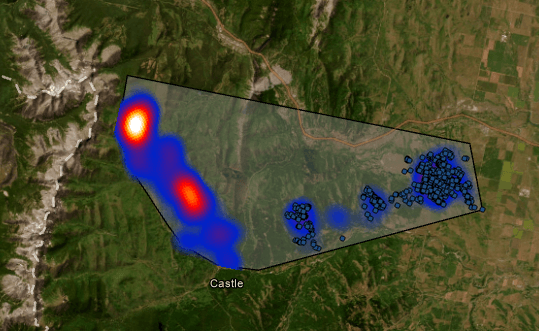
The elk’s winter distribution is concentrated in lower‑elevation valleys, where snow accumulation is lighter and vegetation remains more accessible. These areas provide the conditions necessary for conserving energy during the coldest months. Mainly during November-April Elk #862 is seen grazing the valleys on the eastern down slope of Canadian Rockies. During the harsh cold, the Elk stays downslope for food and easy mobility.
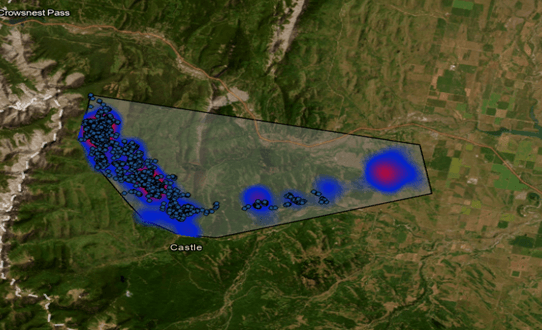
During the summer, mainly between May-October, as warmth advances and temperatures begin to rise, Elk #862 gradually shifts toward higher elevations. This transition coincides with the upward progression of new plant growth, allowing the elk to take advantage of fresh, nutrient‑rich forage as it becomes available. The summer range for this individual lie within the mountainous terrain that forms the natural boundary between Alberta and British Columbia. This region offers cooler temperatures, diverse vegetation, and rugged landscapes that support seasonal foraging and provide refuge from heat and insects.
ELK #876
Elk Tag #876 exhibits a clear and predictable pattern of seasonal movement that aligns with the migratory behaviour commonly observed in elk populations occupying the eastern slopes of the Canadian Rockies. This individual remains within a defined home range throughout the year but shifts between distinct winter and summer habitats in response to environmental changes.
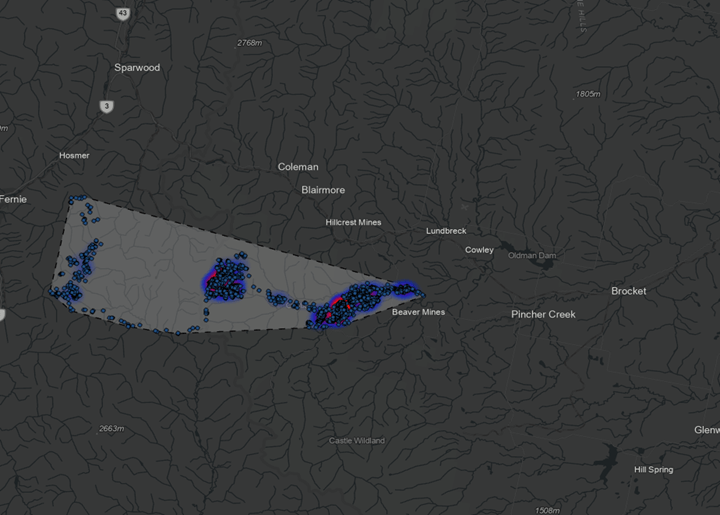
Elk Tag #876 follows a consistent seasonal migration pattern within its established home range, moving between lower‑elevation wintering areas and higher‑elevation summer habitat along the Alberta–British Columbia border. During winter, the elk remains in valley environments where snow depths are reduced and forage is more accessible, supporting energy conservation during periods of limited resources. As spring advances, the animal gradually ascends into the Canadian Rockies, where cooler temperatures and newly emerging vegetation provide optimal summer foraging conditions. With the onset of autumn, Elk Tag #876 returns downslope ahead of winter weather, completing a biannual migratory cycle that aligns habitat use with seasonal changes in climate and food availability.
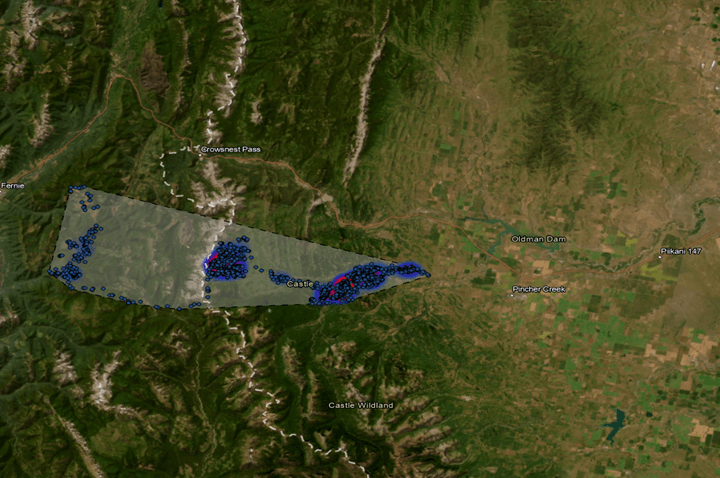
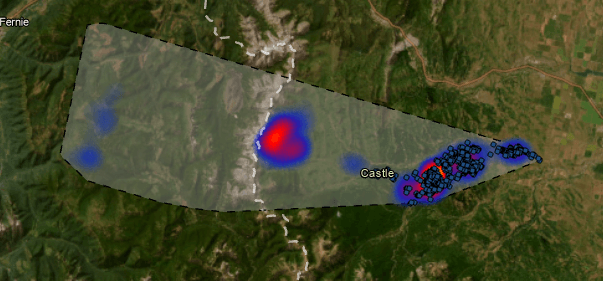
During the winter months, the elk occupies lower‑elevation areas where snow accumulation is lighter and forage remains more accessible. These valley environments provide the conditions necessary for conserving energy during a period when food availability is limited and temperatures are consistently low.
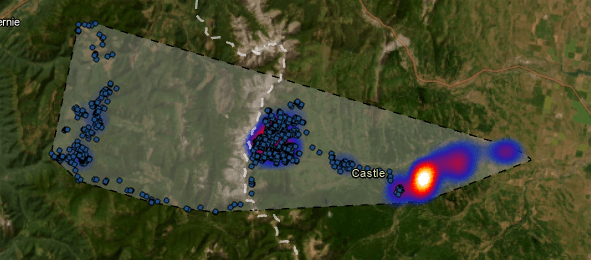
As winter transitions into summer, Elk Tag #876 begins a gradual movement toward higher elevations. This migration to higher elevation means more food as there occurs new plant growth, allowing the elk to take advantage of fresh, nutrient‑rich forage as it becomes available. The summer time from May/April-October for this Elk #876 lies within the mountainous Canadian Rockies between Alberta and British Columbia. This section of the Canadian Rockies offers cooler temperatures, diverse vegetation communities, and rugged terrain that supports seasonal foraging and provides refuge from heat and insect pressure.
Chapter 2.1: Research Summary
This report studied the movement of three Elk #846, #862, and #876. All three elk live in southwestern Alberta, close to the Canadian Rockies. The GPS data shows that each elk follows a regular pattern every year. In winter, they stay in lower areas where there is less snow and food is easier to find. In summer, they move to higher mountain areas along the Alberta–British Columbia border. These mountains give them cooler weather and fresh plants to eat.
The findings might indicate that, during winter, the elk occupies lower‑elevation valley environments where snow depths are reduced and vegetation remains more accessible. This same pattern appears in all three elk. The report also states that “as Summer advances, the animal gradually ascends into the Canadian Rockies, where cooler temperatures and newly emerging vegetation provide optimal summer foraging conditions.” This shows that the elk move with the seasons to find the best food and safest places to live.
Overall, the research shows that elk migration is not random. It is a natural behavior that helps them survive by following food, avoiding deep snow, and using the landscape in a smart way.
Chapter 2.3: Analysis
The movement of Elk #846, #862, and #876 shows a clear pattern. All three elk return to the same winter and summer areas every year. This means these places are important for their survival. The winter areas are valleys and foothills. These places have less snow, so the Elks can walk easily and find food without using too much energy. During the Canadian Winter, these valley environments provide the conditions necessary for conserving energy during the coldest months.
In summer, the Elks move up into the Canadian Rockies. These mountains give them cooler temperatures and new plant growth. The Elks follow this new growth because it is fresh and full of nutrients. This behavior is sometimes called “following the green wave” because the elk move upward as plants start growing at higher elevations.
The hotspot maps in the report show that the elk do not wander randomly. They use the same paths and the same areas again and again. This means the migration routes are important and should be protected. The patterns seen in these three elk are likely similar to many other elk living in the same region.
Chapter 3.0: Recommendation
Based on the elk movement patterns, several steps can help protect these animals:
Protect migration paths The elk use the same routes every year. These paths should stay open and safe so the elk can move freely. Protect summer mountain areas The high‑elevation areas along the Alberta–BC border are very important for elk in summer. These areas should not be disturbed by heavy development. Watch winter valley areas Winter areas are close to towns, farms, and roads. Human activity should be managed so elk still have safe places to feed. We should continue GPS tracking collars give very useful information. More tracking will help understand how elk respond to climate change and land use changes.
Chapter 4.0: Conclusion
The movement of Elk #846, #862, and #876 shows how elk in Alberta survive through the seasons. They move down to valleys in winter to avoid deep snow and find easier food. In summer, they climb into the Canadian Rockies along the Alberta–BC border to reach cooler weather and fresh plants. This pattern repeats every year and is essential for their survival. Understanding these movements helps us protect the places elk depend on and make better decisions for wildlife management in Alberta.
Chapter 5.0: References
1. Alberta Environment and Protected Areas. (2023). Elk Ecology and Management in Alberta. Government of Alberta.
2. Middleton, A. D., et al. (2018). “Green‑wave surfing by large herbivores.” Proceedings of the Royal Society B, 285.
3. Parks Canada. (2022). Ungulate Migration in the Canadian Rockies. Parks Canada Agency.
4. Sawyer, H., & Kauffman, M. J. (2011). “Seasonal migration of ungulates: Ecology and conservation.” Journal of Applied Ecology, 48, 1029–1036.
Internal report data: GPS movement and hotspot maps for Elk #846, #862, and #876. (Quoted lines: “During winter, the elk occupies lower‑elevation valley environments…” and “As spring advances, the animal gradually ascends into the Canadian Rockies…”)