What is a risk?
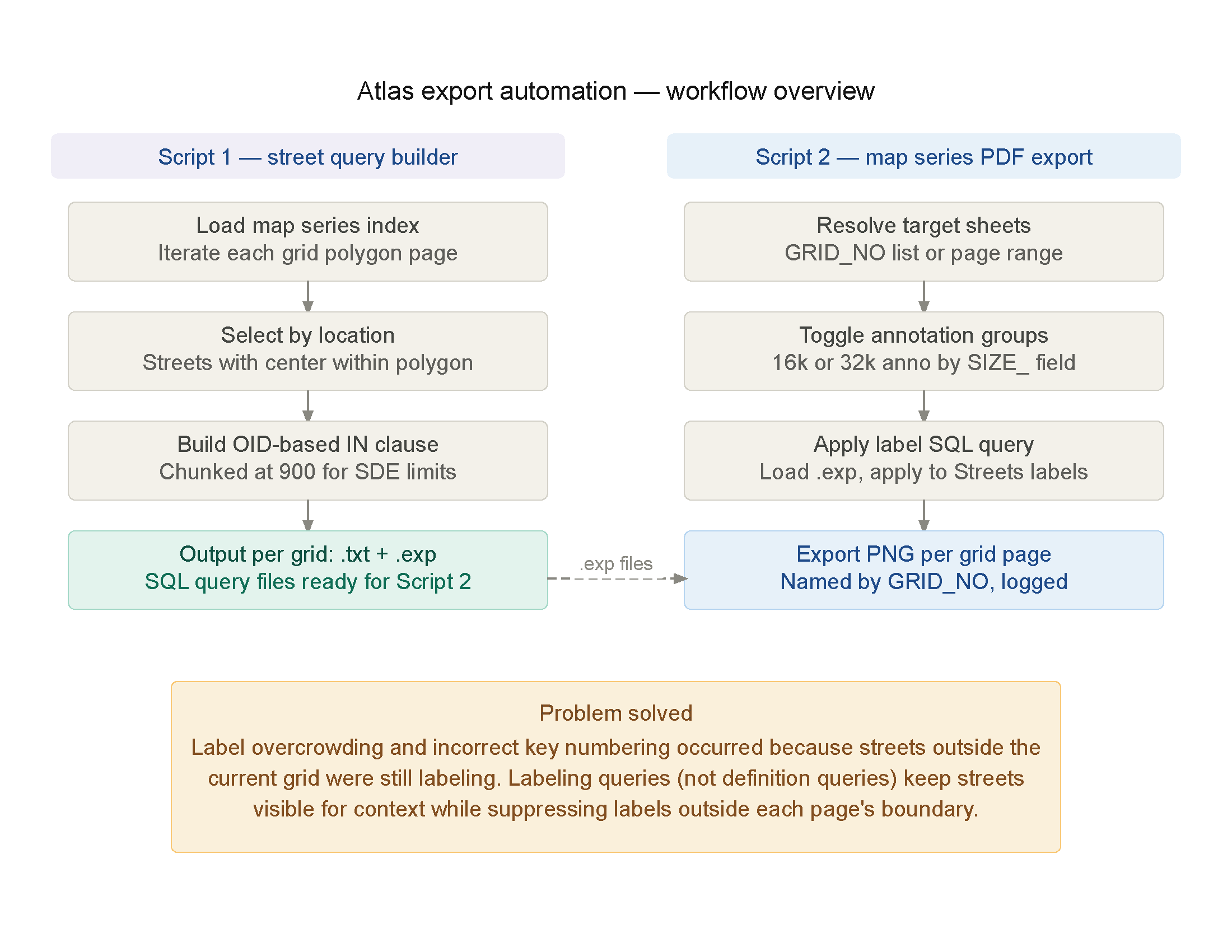
UNISDR (2009) defines risk as the probability of an event and its negative consequences. In simple terms, risk involves the uncertainty and possibility of something going wrong or not turning out as expected, resulting in adverse outcomes. The events could be an accident, an error, a natural disaster, a market fluctuation among others with consequences that include damage to property or assets, additional expenses for repairs or replacements, or a decrease in revenue or income or even loss of life.
For effective management of risks,strategies such as risk assessment, risk mitigation, risk transfer (e.g., insurance), and risk avoidance have been employed. The goal is to identify, analyze, and minimize the likelihood and potential impact of risks, or to transfer the risk to another party. This entails disaster risk management.
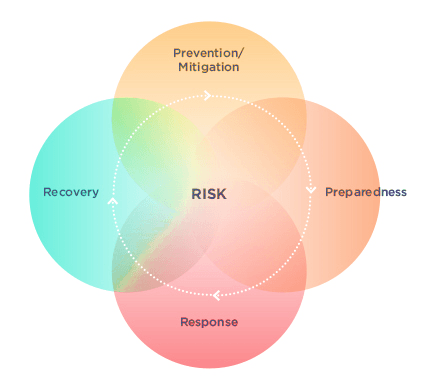
The 4 phases of DRM[ source:https://www.safe-europe.eu/disaster-risk-management-and-emergency-management/ ]
Risk formula
When a hazard(dangerous phenomenon, could be natural or man-made) occurs, people, infrastructure, property,production capacities and other tangible elements within a particular geographical extent will be exposed to the dangers of the hazard. The ability to cope, resist, or recover from hazards in these hazard-prone areas varies depending on the characteristics and situation of people, infrastructure, and other assets, thus determining their vulnerability
RISK=HAZARD X EXPOSURE X VULNERABILITY
To understand risk therefore,these factors need to be combined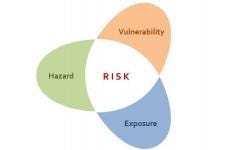
Risk factors[ source:https://www.un-spider.org/risks-and-disasters/disaster-risk-management ]
Probabilistic hazard modelling
As aforementioned, risks involve uncertainties and these stem from: the randomness of both natural and man-made hazards which makes prediction of their occurrence and characteristics quite a challenge. Furthermore, our understanding and measurement of hazards, exposures and vulnerability is incomplete due to technological constraints, data gaps as well as insufficient scientific understanding.For example, quantification of exposure and vulnerability factors such as building standards, emergency response capabilities etc is difficult due to various complex factors such as socio-economic dynamics, urban sprawl among others.
A probabilistic approach in risk analysis deals with these uncertainties. It quantifies and analyzes the probability of occurrence of various events and offers a range of possible outcomes. This approach relies on statistical methods, historical data analysis, expert judgment and simulation models.It is important to note that the uncertainties are not eliminated but rather a framework is provided to manage them through assumptions for example.
How does this works? It uses historical data to recreate the physics of a phenomenon. These events are then enriched with a large number of synthetic events using statistical, physical and theoretical models. The output is an estimate of potential economic loss such as average annual loss(AAL) and probable maximum loss(PML) for different return periods.AAL represents the average amount of loss that can be expected to occur annually while PML quantifies the potential maximum financial loss(worst-case scenario).
Most probabilistic risk models have been developed commercially for insurance companies and are therefore not readily available. Good stride has been made in the development of publicly available models cus as OASIS,GEM,CLIMADA among others. A challenge however remains in the fact that methodologies and data used vary making comparison difficult. We shall focus on one of this methods(CLIMADA) to quantify risk in Madagascar as a result of tropical cyclones.
CLIMADA(CLIMate ADAptation)
This is a python framework with classes,methods and data to calculate risk by combining exposure, hazard and hazard functions(vulnerability functions). Users can access the data available in the platform using a data API or they can incorporate their own data.
The main features and capabilities of CLIMADA for modelling the risk of a tropical cyclone hazard include:
Hazard modelling
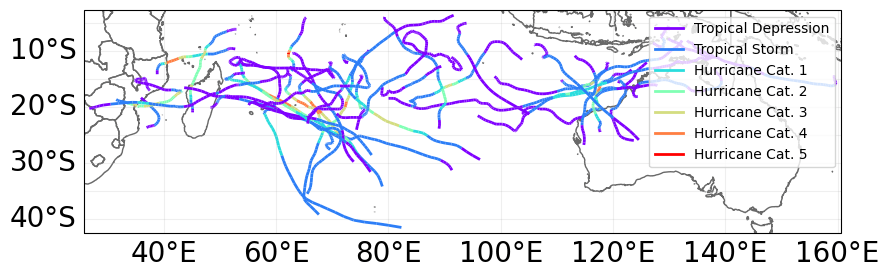
The hazard class creates storm tracks from historical data obtained from IBTRaCS archive(This data has to be downloaded first to the local disk). It then defines geographical centroids. This are the areas for which we want to calculate the hazard. The data can be filtered to a particular basin or date-range where basins include: East Pacific(EP), North Atlantic(NA), North Indian(NI), South Atlantic(SA), South Indian(SI), South Pacific(SP), and the West Pacific(WP)while time periods starts from 1980 to latest available year, which is up to 2020 as of the time this article is written.
from climada.hazard import TCTracks, TropCyclone, Centroids

# Load historical tropical cyclone tracks from ibtracs over the South Indian basin between 2010-2022
hist = TCTracks.from_ibtracs_netcdf(provider='usa', basin='SI', year_range=(2019, 2022))
print('num tracks hist:', hist.size)

hist.equal_timestep(0.5)  # Interpolation to make the track smooth and to allow applying calc_perturbed_trajectories
# Add 1 randomly generated(synthetic) track per historical track
hist.calc_perturbed_trajectories(nb_synth_tracks=1)
print('num tracks hist+syn:', hist.size)

# visualize tracks
ax = hist.plot()
ax.get_legend()._loc = 2
# Define the centroids from the exposures position or you can provide alist of coordinates using either of these two
#min_lat, max_lat, min_lon, max_lon = -25, -10, 40, 50 ( Define bounding box for Madagascar)
#tracks_madagascar = tracks.filter(lat_min=min_lat, lat_max=max_lat, lon_min=min_lon, lon_max=max_lon)
or
lat = exp_lp.gdf['latitude'].values #refers to the exposures geodataframe
lon = exp_lp.gdf['longitude'].values #refers to the exposures geodataframe
centrs = Centroids.from_lat_lon(lat, lon)
centrs.check()

#visualize a subset i.e the 2019 Intense Tropical Cyclone Belna.
hist.subset({"sid": "2019336S06055"}).plot();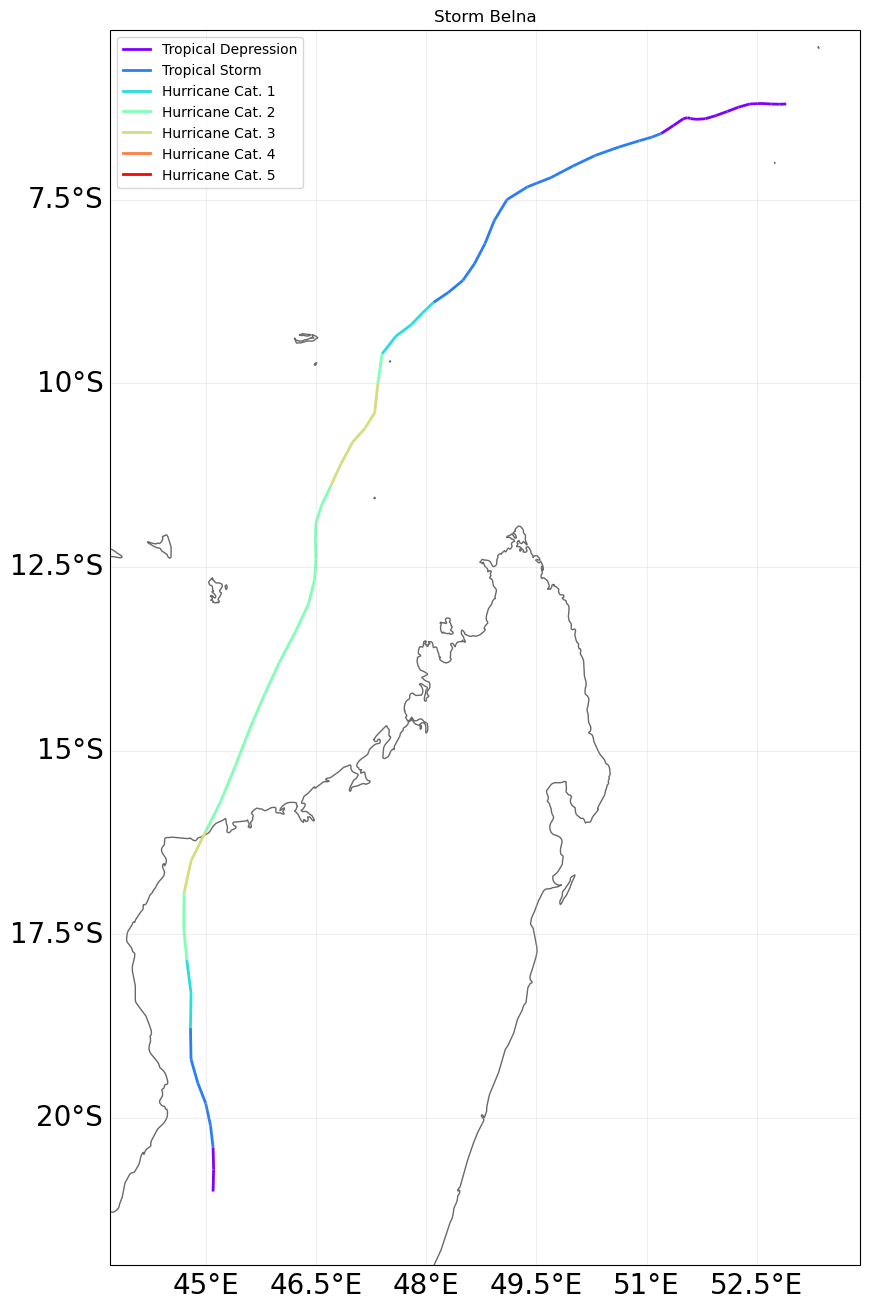
Storm Belna track
# Define the centroids from the exposures position
lat = exp_lp.gdf['latitude'].values
lon = exp_lp.gdf['longitude'].values
centrs = Centroids.from_lat_lon(lat, lon)
centrs.check()

# Enrich the tracks by computing the windspeed at the location of the centroids
tc = TropCyclone.from_tracks(hist, centroids=centrs)
tc.check()

tc.plot_intensity(event='2019336S06055');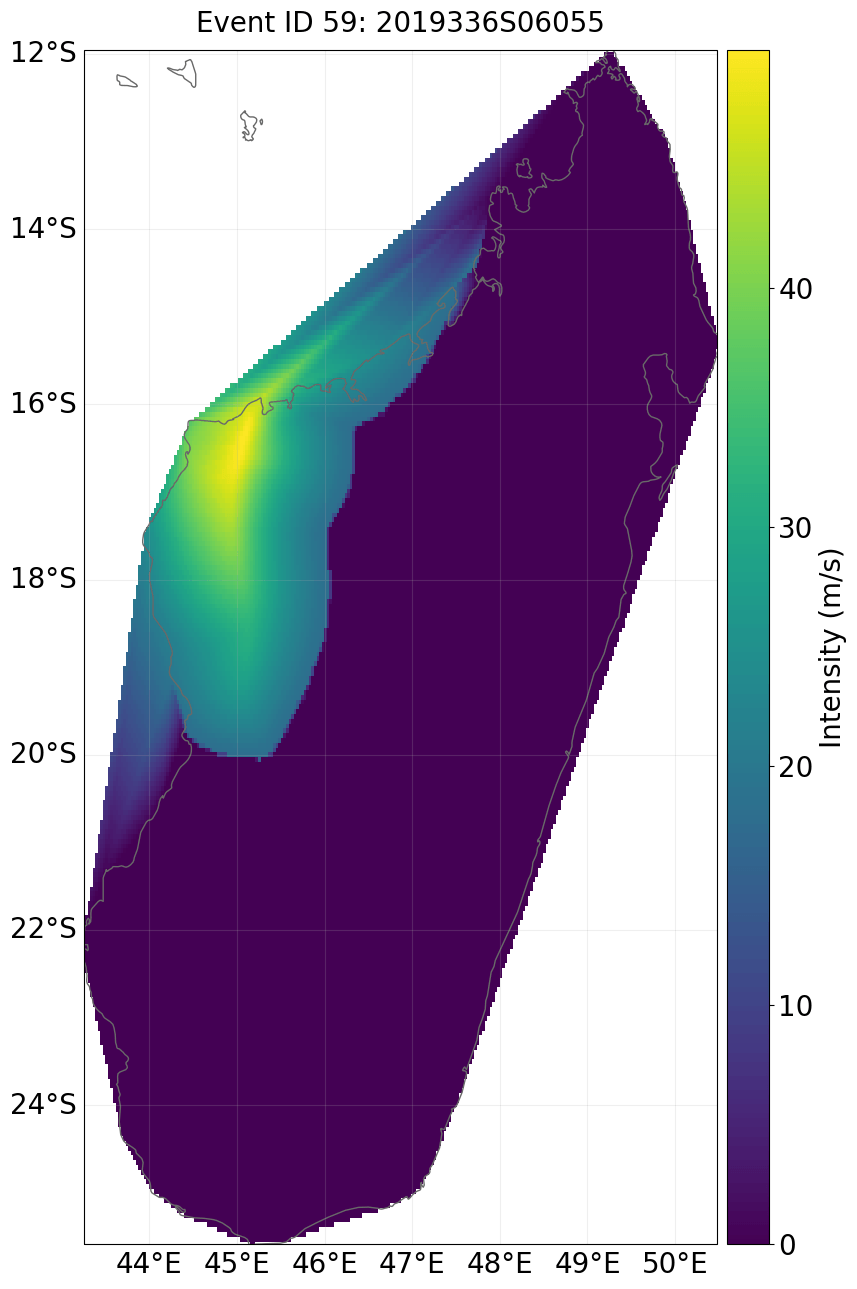
Storm Belna intensity
Exposure modelling
CLIMADA incorporates a socio-economic model known as LitPop that breaks down asset value data in a way that is proportionate to a combination of nighttime light intensity and gridded population data. All assets exposed to a hazard are assigned a value(dollar or population)based on available data for each country i.e could be produced capital or GDP or average GDP to wealth ratio(all from The World Bank)
The gridded nightlight intensity data(from NASA Black Marble nighttime light) and population data(from Gridded Population of the World) are combined to generate a digital number at each grid level cell. Produced capital is then disaggregated to this digital number to generate an asset exposure per grid cell.
CLIMADA offers the method LitPop.set, which, when executed, retrieves all the required data except for population data, which is obtained from SEDAC through a separate download. It is also possible to load one’s own data in the form of geodataframe/dataframe or excel file.
# Exposure from the module Litpop
# Note that the file gpw_v4_population_count_rev11_2015_30_sec.tif must be downloaded (do not forget to unzip) if


%matplotlib inline
import numpy as np
from climada.entity import LitPop

# Madagascar with resolution 10km and financial_mode = pc.
#other fin_modes applicate to different countries include gdp,pop,income group,nfw,tw,norm(https://climada-python.readthedocs.io/en/latest/tutorial/climada_entity_LitPop.html)
exp_lp = LitPop.from_countries(countries=['MDG'], res_arcsec=120, fin_mode='pc',exponents=(1,1))
Vulnerability modelling
The ImpactFuncSet encompasses a collection of functions that quantify the effects of hazards on exposures in various ways, such as the percentage of monetary value lost for a building or the mortality rate, among other measures. From this we get the following measures; the expected annual impact per exposure, the total average annual impact and the probable maximum impact for different return periods.
#https://climada-python.readthedocs.io/en/latest/tutorial/climada_engine_Impact.html
from climada.entity import ImpactFuncSet, ImpfTropCyclone
# impact function TC
impf_tc = ImpfTropCyclone.from_emanuel_usa()

# add the impact function to an Impact function set
impf_set = ImpactFuncSet([impf_tc])
impf_set.check()

# Compute impact:requires an Exposure(exp_lp) , an ImpactFuncSet(impf_set), and a Hazard(tc) object
from climada.engine import ImpactCalc
imp = ImpactCalc(exp_lp, impf_set, tc).impact(save_mat=False)
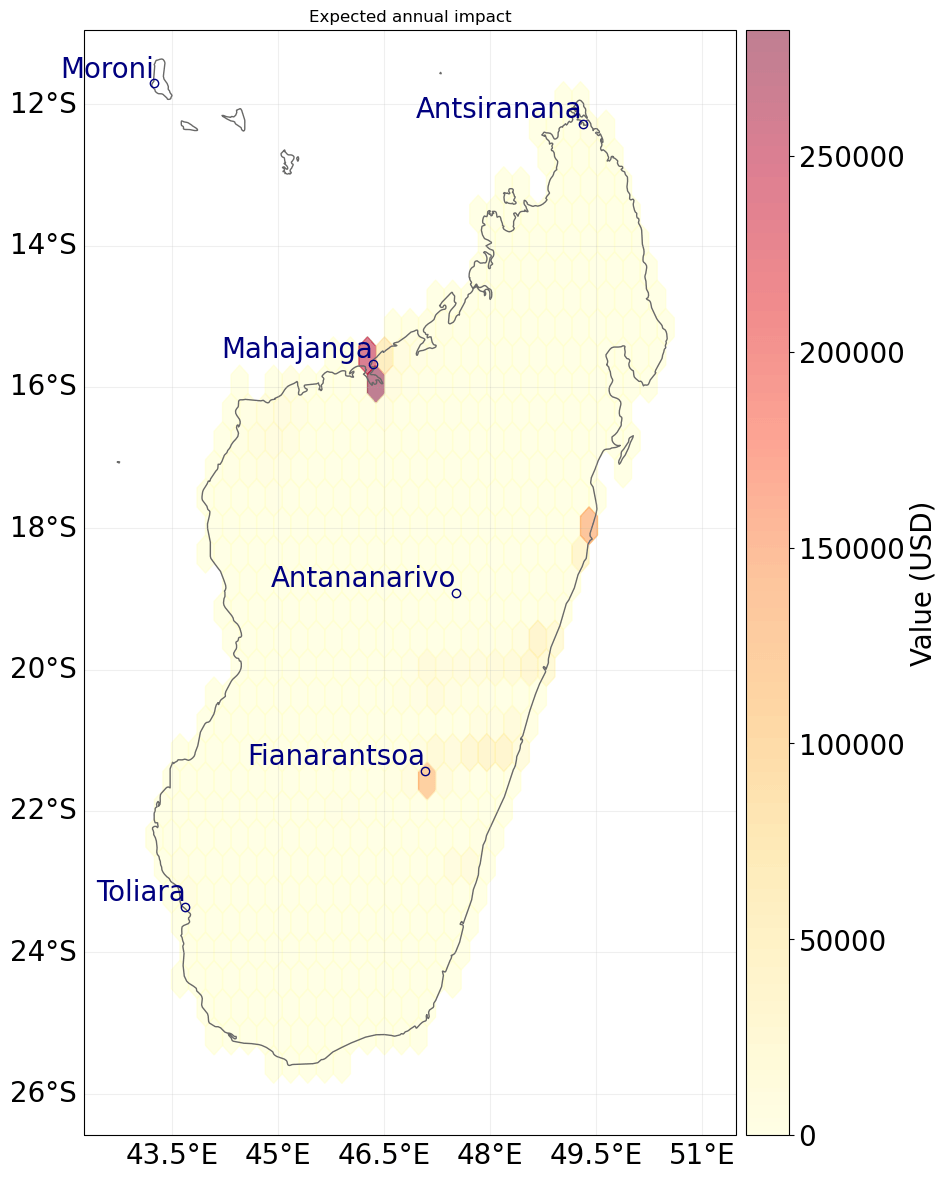
To obtain the aggregated average annual impact or plot the average annual impact in each exposure location:
print(f"Aggregated average annual impact: {round(imp.aai_agg,0)} $")
imp.plot_hexbin_eai_exposure(buffer=1,gridsize=30, cmap='YlOrRd', alpha=0.5);
Aggregated average annual impact: $1474609.00
Conclusion
The featured tool in this article offers an assessment of the economic consequences resulting from a natural disaster. It assumes that nightlight intensity and population density are proxies for spatial distribution of asset exposure. This comes in handy especially because asset value data is in most cases commercial. This tool therefore provides an alternative.
It is crucial to acknowledge that apart from the mentioned functionality, there is a wide range of additional features available, which can be explored in detail at the provided link.
References
Aznar-Siguan, G. and Bresch, D. N., 2019: CLIMADA v1: a global weather and climate risk assessment platform, Geosci. Model Dev., 12, 3085–3097, https://doi.org/10.5194/gmd-12-3085-2019
Bresch, D. N. and Aznar-Siguan, G., 2021: CLIMADA v1.4.1: towards a globally consistent adaptation options appraisal tool, Geosci. Model Dev., 14, 351–363, https://doi.org/10.5194/gmd-14-351-2021
Eberenz, S., Stocker, D., Röösli, T., & Bresch, D. N. (2020). Asset exposure data for global physical risk assessment. Earth System Science Data, 12(2), 817–833. https://doi.org/10.5194/essd-12-817-2020